
How a Glasses Size Guide Stopped Me From Wasting Money on Reading Glas…
페이지 정보

본문
How a Glasses Size Guide Stopped Me From Wasting Money on Reading Glasses
Last month, I found myself staring at a stack of three returned glasses boxes on my kitchen table. Every single pair had cost me money. Every single pair was wrong. My eyes were exhausted, my wallet had taken a beating, and I still couldn't make out the words on a simple recipe card without squinting.
"Why is this so hard?" I muttered out loud, completely exasperated.
My partner walked in, glanced at the pile, and shrugged. "Maybe you're just buying the wrong size," she said. Simple words, but they completely shifted my perspective.
The Problem: Guessing My Way Through Glasses Shopping
Here's what I did wrong for years. I walked into stores or scrolled through online listings, picking frames that looked decent and selecting a strength that felt roughly right. I never once stopped to consult a glasses size guide.
The result? Frames that pinched my temples, lenses that sat too low, and reading glasses that gave me a pounding headache within twenty minutes. I've read horror stories from people who dropped $500 or $900 on glasses that never worked for them—progressives with viewing areas so narrow they had to bob their heads up and down, or store credit traps that swallowed their cash. I was done with that.
The simple truth is that glasses come with specific measurements. Those measurements actually matter. Skip the glasses size guide, and you're basically gambling with both your comfort and your money.
What I Learned About Glasses Sizing
A glasses size guide really boils down to three key numbers, usually printed along the inside of any frame's temple arm.
- Lens width — The horizontal width of a single lens, measured in millimeters. For reading glasses, 50-55mm generally works well for most faces.
- Bridge width — The gap between the two lenses that rests on your nose, typically falling between 16-22mm.
- Temple length — The length of the arms from the hinge to the tip of your ear. Common sizes range from 135-145mm.
Action step: Grab a pair of glasses that fits you perfectly right now. Look inside the arm, write down those three numbers, and use them as your baseline for every new pair you consider.
The Turning Point: Finding the brand
After my partner's comment, I spent an evening doing serious research. I measured an old pair of sunglasses that fit me flawlessly, wrote down my numbers, and started searching for reading glasses that matched.
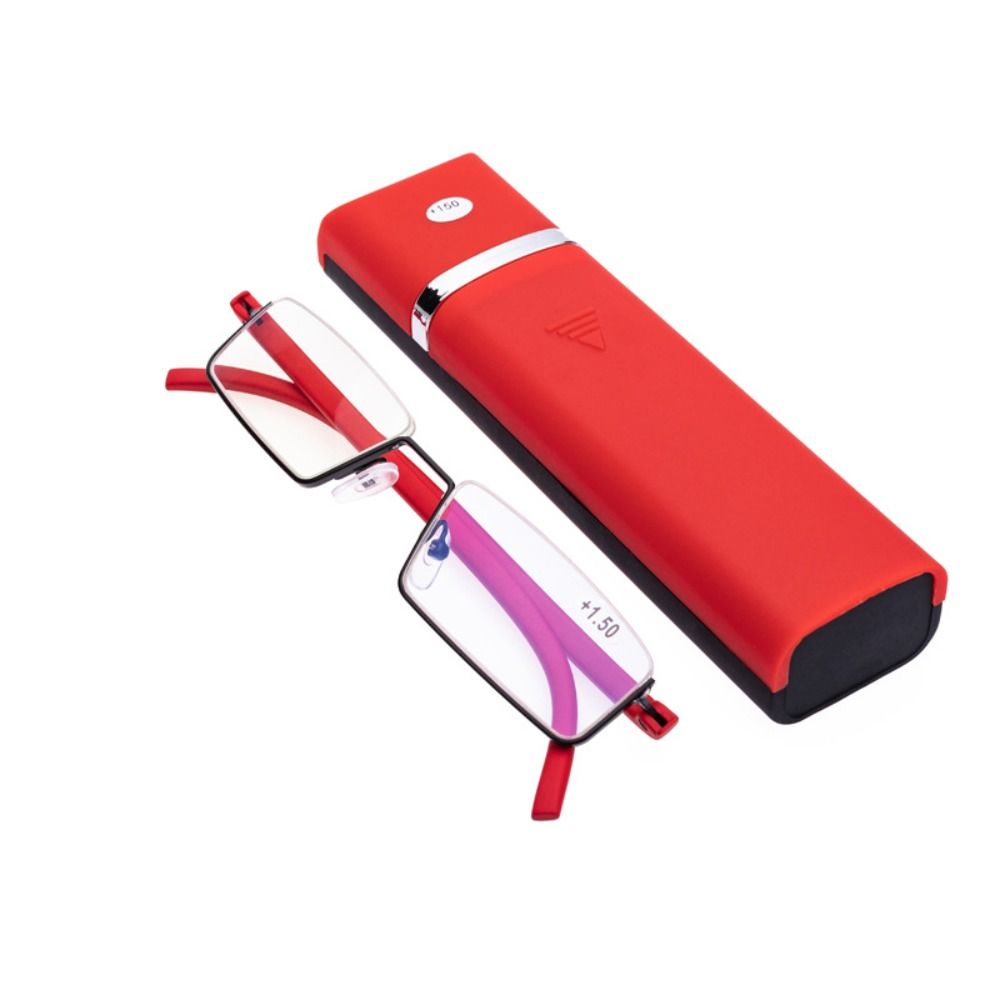
That's when I came across the brand. I landed on their homepage and spotted their Metal Reading Glasses with Case. The red rectangle half-frame design immediately caught my eye, but what really impressed me was the level of detail. TR PC frame material, anti-eyestrain lenses, strength options ranging from 1.0 all the way up to 4.0, and the frame measurements listed clearly so I could check them against my own.
I compared their glasses size guide numbers with my measurements, and they lined up perfectly. The half-frame rectangle shape meant the lenses wouldn't block my lower vision when I looked up from a book, and the metal construction felt like it would hold up much better than the cheap plastic pairs I had been cycling through.
The price was low, which made me cautious. Super cheap glasses often come with flimsy hinges, blurry lenses, or frames that bend out of shape within a week. But TR PC material is known for being both flexible and durable, and the included case meant I wouldn't scratch them up in my bag like I did with my last pair.
Verdict: I ordered the 2.0 strength in red. The total risk was minimal, but my hope was high.
Life After: The First Day and Beyond
On the first day I wore them, I sat down with my morning newspaper. The words were razor-sharp. No squinting, no leaning forward. And because of the half-frame design, when I glanced up at my coffee mug, I could see it clearly without looking through the lens.
A week later, I was reading a recipe on my phone at arm's length without any headache or eye strain. The anti-eyestrain coating genuinely seemed to make a difference during longer reading sessions at night.
"Where did you get those?" my neighbor asked one afternoon when she saw me reading on the porch without my usual squint-face. I told her about measuring first, checking a glasses size guide, and then finding a pair that actually matched.
Three Real Scenarios Where These Glasses Worked
- Reading in bed: The lightweight metal frame doesn't dig into my head when I lean against a pillow. I wore them for 45 minutes straight with zero discomfort.
- Working at my desk: I keep them in the included case next to my keyboard. The half-frame lets me look over the top at my monitor and then down through the lens for printed documents. No annoying head-bobbing like those poorly designed progressives that people complain about.
- Checking price tags at the store: I toss the case in my jacket pocket. On and off in seconds. The rectangle shape provides a wide enough lens to read small print without tilting my head.
How to Pick the Right Strength
This part trips a lot of people up. Here's a simple breakdown:
- 1.0x — You just need a tiny boost. Small print is slightly fuzzy.
- 1.5x — You find yourself holding your phone just a bit further away than you used to.
- 2.0x — Books and menus are hard to read at a normal distance.
- 2.5x — You basically need things at arm's length to see them clearly.
- 3.0x to 4.0x — Close-up work like sewing or reading fine print requires strong magnification.
Action step: If you're unsure, start with a lower strength. You can always move up later. Going too strong too fast will give you headaches almost immediately.
The Price-Quality Reality
Let me be honest with you. These the brand glasses are budget-friendly, which means you shouldn't expect the same custom-ground lens quality as a $300 pair from an optometrist. But here's the tradeoff that works heavily in your favor:
- For basic reading magnification, you don't need expensive custom lenses.
- The TR PC material is genuinely flexible and holds its shape well over time.
- The metal frame feels noticeably more solid than all-plastic readers at the same price point.
- You get a case included, which automatically extends the life of any pair.
Research tip: Before buying, check real buyer photos in the reviews. Look closely at how the frames sit on different face shapes, and compare the listed measurements against your own glasses size guide numbers.
My Buying Process Now
After all those failed purchases, I now follow a simple system:
- Step 1: Measure a pair that fits me well.
- Step 2: Check the glasses size guide for any new pair I'm considering.
- Step 3: Read real reviews and focus on comments about fit, not just looks.
- Step 4: Start with one pair before buying multiples.
Back to the Kitchen Table
That stack of returned boxes is gone now. In its place sits one red case with one pair of the brand half-frame readers inside. They're the pair I reach for every single morning. They're the pair that finally fits—because I stopped guessing and started measuring.
If you've been frustrated by glasses that never seem to work, the fix might not be spending more money. It might just be learning your own numbers. A good glasses size guide takes less than five minutes to use, and those five minutes saved me months of headaches—both the literal kind and the financial kind.
Final verdict: Measure first. Compare second. Check reviews third. Then buy with confidence.
- 이전글파워약국 Vimax 구매 체크리스트 26.07.09
- 다음글활력이 줄면서 떨어지는 남성 자신감, 성인약국 — 심리·신체 관리법, 방치하면 안 되는 이유 26.07.09
댓글목록
등록된 댓글이 없습니다.